

I planned my Tuesday in 15-minute increments.
Color-coded spreadsheet. Three highlight shades. One for “deep work,” one for “shallow work,” one for “aspirational work,” which was just things I’d never actually do written in a fancier font. Thirty-four entries. I had a legend. Like a cartographer mapping a continent that doesn’t exist.
By 9:49 am I’d missed my first block. By 10:15 I was four blocks behind and doing something I called “mega-blocking,” which is a fancy way of saying panic. By noon the spreadsheet looked like a crime scene and I was watching a guy on YouTube explain the Pomodoro technique while eating Fruity Pebbles straight from the box.
The whole system lasted 1 hour and 38 minutes. I’ve cleared customs in 4 countries with more flexibility. (At least at the border, nobody judges you for standing still.)
So I built something dumber.
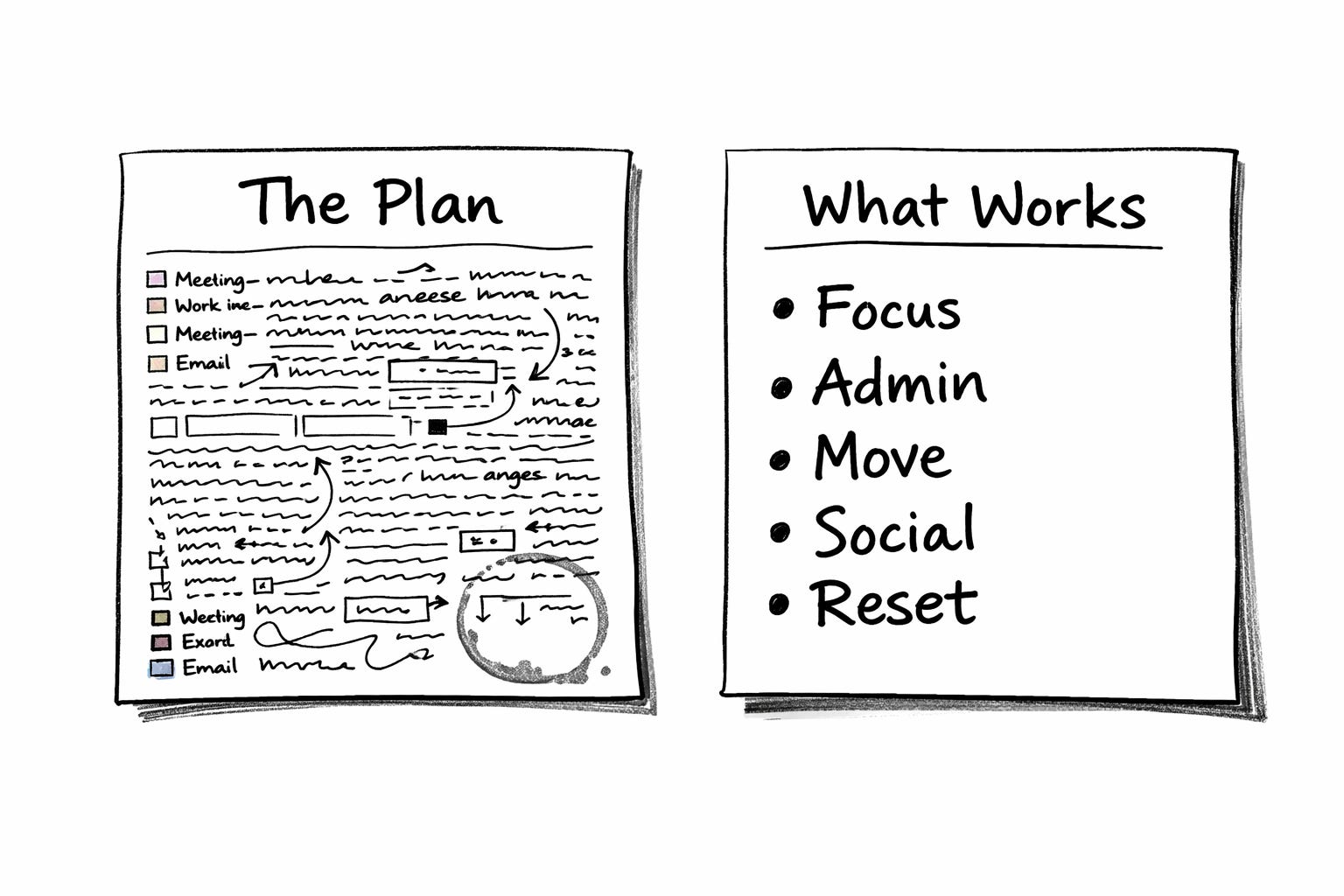
The Setup (2 min): Write down five words:
Focus. Admin. Move. Social. Reset.
Sticky note, phone, back of your hand. That’s your whole planner now. No Trello boards. No Notion dashboards. No color-coded anything. (Building the system was the procrastination. We just couldn't admit it.)
The Fix (daily):
Five blocks. They float. They don’t care what time it is. They don’t care about your morning routine fantasy.
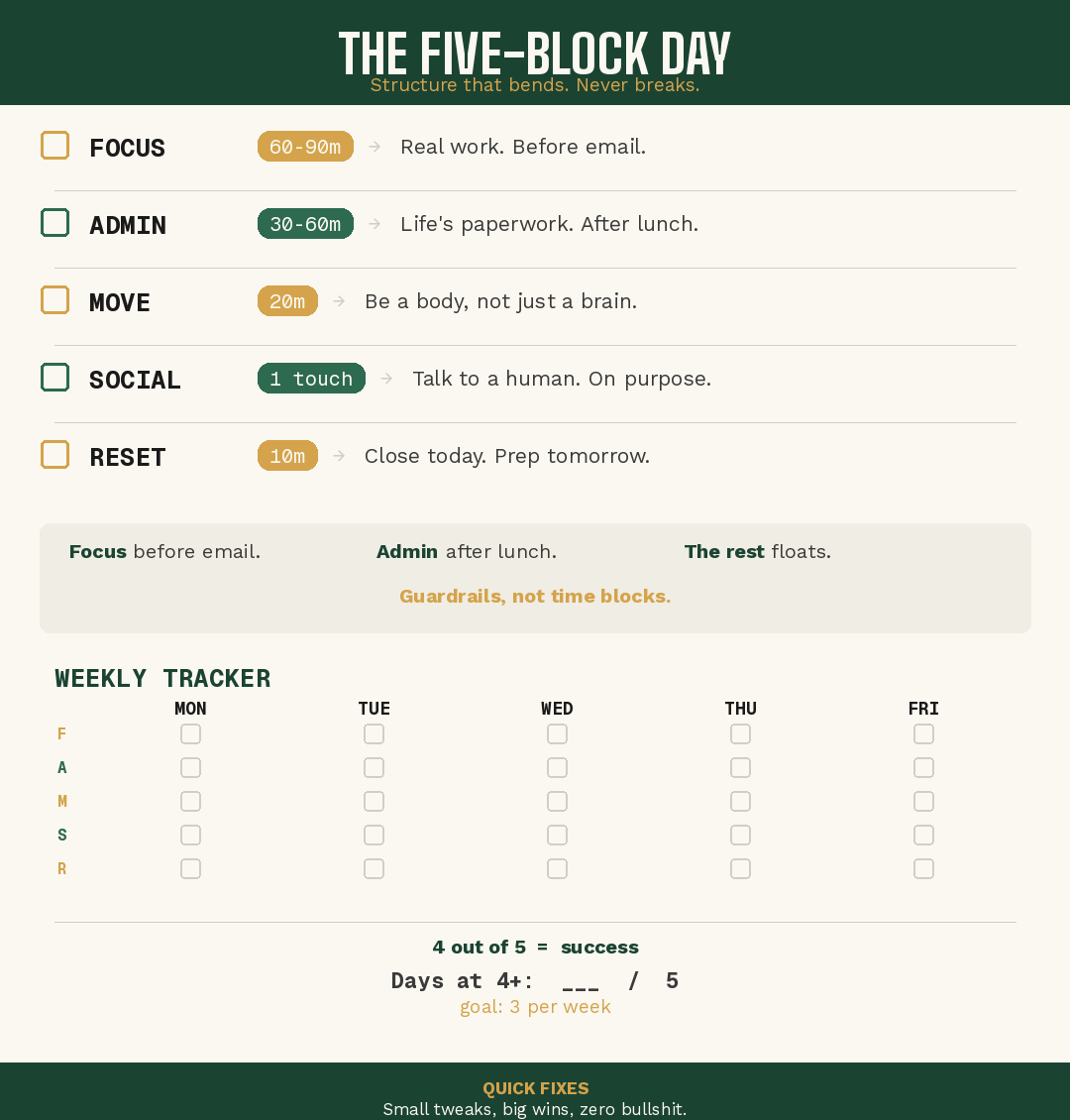
Focus (60-90 min). The real work. Your one big thing for the day. Do it first. Before email. Before the news. Before your phone starts screaming. Your brain at 7am is a scalpel. Your brain after 40 minutes of email is a butter knife. (I don’t make the rules. Neuroscience makes the rules. I just keep proving them right.)
Admin (30-60 min). Email, bills, forms, scheduling, that thing you’ve been avoiding for nine days and counting. All the crap that keeps your life technically running. Batch it after lunch. You’re already mentally tired by then, and nobody in the history of human civilization has done their best creative work while reconciling a bank statement. (If you have, that’s not a flex. That’s a symptom.)
Move (20 min). Walk. Stretch. Do squats. Acknowledge that you have a body and it’s been filing formal complaints since Tuesday. If you’ve been doing the Five-Minute Movement, this is its older sibling. If you haven’t... just walk for 20 minutes. The bar is on the floor. We put it there on purpose.
Social (one touchpoint). Text someone. Call your mother. Have a conversation with a human that doesn’t involve a support ticket. One real interaction. That’s the whole block. (I once realized I hadn’t spoken in eleven days only because a cashier said “hello” and I flinched. This block isn’t optional for me. Treat it the same.)
Reset (10 min). Last thing before you close the laptop. Write down tomorrow’s Focus task. Close the tabs you somehow opened again. That’s it. This ten minutes is why tomorrow doesn’t start with a spiral. Skip it and tomorrow’s you will curse today’s you. Rightfully.
Two rules: Focus before email. Admin after lunch. The rest floats. Guardrails, not time blocks.
Why it works: Rigid schedules shatter on contact with a real Wednesday. A car alarm goes off for 45 minutes. Your landlord shows up to fix something and breaks something else. Your smoke detector starts chirping at the exact frequency that makes rational thought impossible. Floating blocks survive because they only care about sequence, not clock time. Miss your Focus block at 9? Do it at 10. Nobody died. (Probably. I haven't checked.)
The Rules:
DO: Check off blocks as you finish them (free dopamine, no prescription required)
SKIP: Assigning specific clock times to blocks (one minute you’re adding times, the next you’re building a dashboard, the next you’re optimizing the dashboard instead of doing anything on it)
When Life Gets Weird:
Crisis mode: Focus + Reset only. Two blocks. That’s a valid day. Not a great day, but a real one.
Weekend mode: Move + Social. The rest can wait. Weekends are for being a person. Full stop. No qualifiers.
Travel day: All five blocks at 10 minutes each. Airport Focus is still Focus. Somehow.
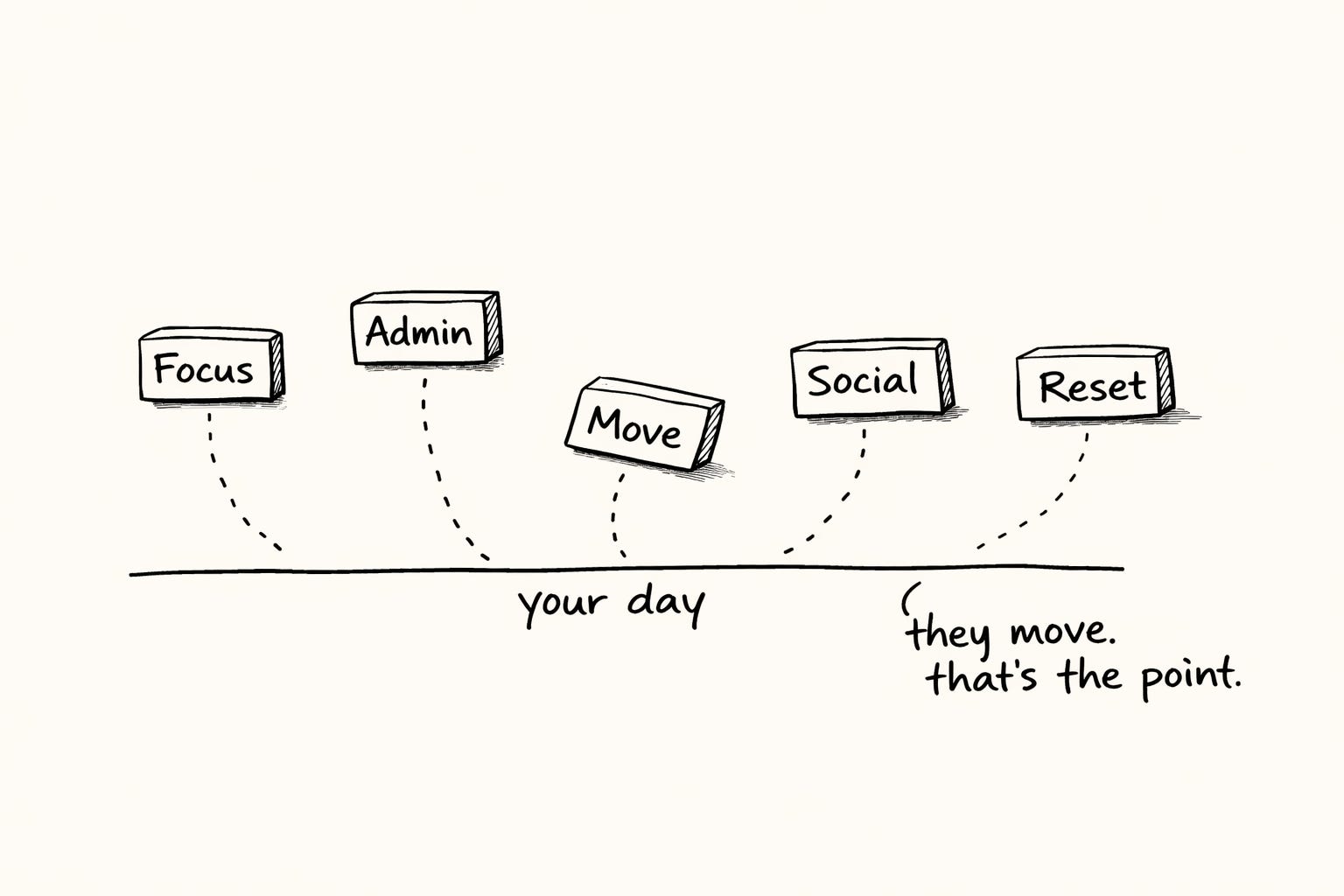
Keep it loose: Four out of five blocks = you won the day. Not five. Four. Leave room to be a human who occasionally stares at a wall for twenty minutes and calls it “processing.” (That’s not a block. But it probably should be.)
Your scorecard: Count your 4+ block days this week. Three or more and you’ve got a system. A real one. One that doesn’t require a legend or three highlight shades or the emotional stability of a monk.
🧉 Reply with the name of the app or system you feel most guilty about abandoning. Just the name. No explanation. I’ll know. (Mine is a bullet journal with custom index tabs, three colors of washi tape, and a hand-drawn habit tracker I maintained for exactly one habit: drawing the habit tracker.)
Fixed (for now!),
Nick “Five Blocks Is Plenty” Quick

PS… My Focus block today was writing this newsletter. It started at noon because insomnia had other plans for my morning. Admin and Move were the same block — took Butters on a long walk to pay my cell bill. Fifteen blocks, one leash. Social was reaching out to an old friend I’d fallen out of touch with but shouldn’t have. (I’ve been making myself do one of those a week. It’s uncomfortable every time. Nobody has been anything but glad to hear from me. There’s a lesson in there I’m still learning.) Reset was organizing and indexing every previous issue of this newsletter so I stop losing track of what I’ve already written. Total planning time: zero. Total things done: five. The system is dumber than every system I tried before it. Turns out dumber was what I needed the whole time.
PPS… Next week: The Friction Log. That keyboard with the sticky spacebar. That app that loads like it’s running on a potato. That drawer you’ve been hip-checking closed for six months. We’re logging every tiny annoyance and killing one per week.
Regarding the topic of the article, your insight into planning as procrastination really ressonated. What if this 'human-centric' block system was applied to agile project management workflows? It sugests a robust, yet flexible, model for team task allocation, avoiding analysis paralysis.